

Should the CRO own commercial strategy in a PE-backed SaaS company?
In a PE-backed SaaS company, commercial strategy is most effective when owned by the CEO because the CEO is the only role with both the authority and full-system visibility to coordinate activities across the organization and direct them toward the company’s long-term growth objectives and the investor’s thesis. When this responsibility is delegated to the CRO, strategy can become functionally optimized rather than systemically aligned, leading to disconnected narratives and fragmented execution. For the CEO, this often shows up as loss of board confidence, reduced control over the business, slower decision-making, and increased performance risk. A more effective approach is a CEO-led commercial model, where the CEO owns commercial direction and the CRO owns execution against that direction. The Push Order of Operations provides the structure that makes this division of responsibility clear and operational.
Why This Happens
The CEO vs CRO commercial strategy dynamic is often misunderstood in PE-backed SaaS companies.
A CEO hires (or inherits) a CRO and assumes they will own go-to-market strategy. The title suggests it. Revenue sits in their domain. The board often reinforces this division of responsibility.
On the surface, it feels logical: the CEO leads the company, the CRO leads revenue.
The issue is structural. The CRO is responsible for optimizing within the commercial function: pipeline generation, conversion, and deal execution. That work is critical.
But the CRO does not typically have full visibility from the investment thesis through the sequence of growth decisions to the exit narrative. They are also not positioned to coordinate change across all functions in the organization.
The CEO is the only role with both the end-to-end view and the authority to align teams against a single commercial direction.
That difference in visibility and authority is what creates the gap.
What Happens When the CRO Owns Commercial Strategy in PE-Backed SaaS
The Board Hears Two Narratives
When commercial strategy is not clearly owned by the CEO, the board often hears two versions of the story.
The CEO presents direction and positioning.
The CRO presents pipeline performance and execution metrics.
Both are valid, but without a clear connection between them, it becomes harder for the board to assess progress. Over time, this can lead to more scrutiny and less confidence in the plan.
The CEO Loses the Growth Story
If the CEO is not directly shaping commercial strategy, it becomes more difficult to explain results with clarity.
Questions about pipeline performance, changes in trajectory, or next-quarter priorities often get redirected to the CRO.
Over time, this creates distance between the CEO and the growth narrative, the story that connects results, decisions, and forward plans. In a PE-backed environment, that narrative is one of the CEO’s primary tools for building board confidence.
Without direct ownership, the narrative can start to feel reactive rather than intentional.
Execution Fragments Across Functions
Without a single point of strategic coordination, each function tends to optimize independently.
- Marketing defines its own version of the ICP
- Sales builds territories based on coverage needs
- RevOps structures reporting and attribution
- Finance models contribution separately
Each decision can make sense in isolation. But without alignment across them, the system becomes harder to manage and less predictable in its output.
The result is often a team working hard, but not always in the same direction.
CEO-Led Commercial Model
The solution is not to reduce the CRO’s scope. It is to clarify roles.
In a CEO-led commercial model, the CEO owns commercial direction and the CRO owns execution against that direction.
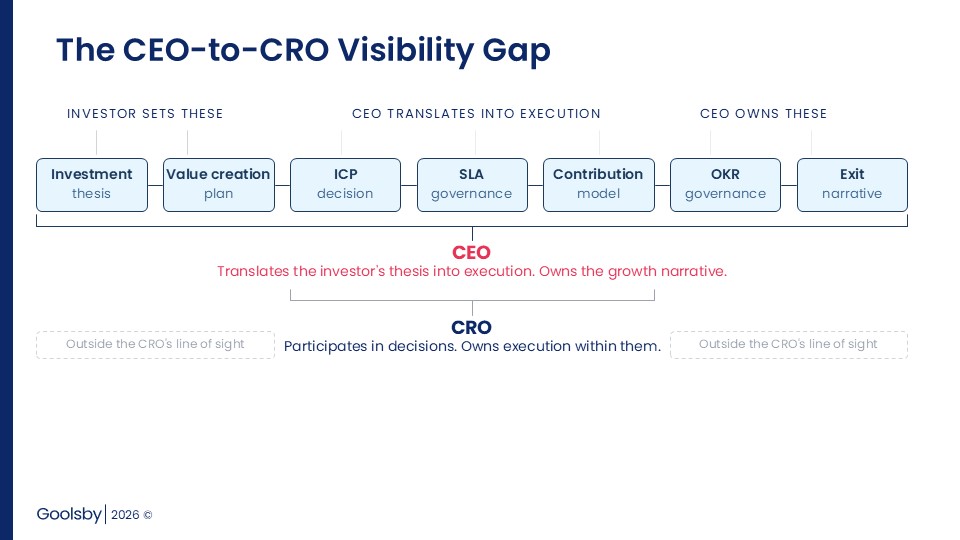
The CEO owns:
- The Exit Targets aligned to the investment thesis
- The sequencing of growth decisions
- The growth narrative presented to the board
- The OKR framework tied to exit outcomes
The CRO owns:
- Pipeline generation and management
- Sales execution and performance
- Quota attainment and deal strategy
- Execution within defined SLAs
This creates a clear boundary: the CEO defines direction, and the CRO drives execution within it.
The result is a commercial system that is easier to align internally and easier to explain at the board level.
How the Push Framework Operationalizes This Structure
The Push Framework translates this model into a working system.
It defines a sequence of CEO-owned decisions:
- ICP
- SLA
- Contribution
- OKRs
These decisions are not delegated. They shape how the commercial system operates and how performance is measured.
Between these decision points, execution is led by the CRO and functional teams:
- RevOps runs segmentation and analysis
- Marketing builds personas and programs
- Sales defines coverage and execution
- Finance models contribution targets
The CEO is not managing execution. The CEO is ensuring that the decisions guiding execution are clear, aligned, and connected to the investment thesis.
That is what owning commercial strategy looks like in practice.
Frequently Asked Questions
What if the CRO resists this structure?
Frame it as clarity, not constraint. In many cases, CROs are operating without a fully defined strategic system. This approach provides one.
What if the CRO is more experienced than the CEO?
That experience is valuable input. It does not change the CEO’s role in setting direction and owning the growth narrative.
Is this micromanagement?
No. Micromanagement is tactical. This model separates strategy (CEO) from execution (CRO), which typically reduces unnecessary involvement in day-to-day operations.
How does this apply if we do not have a CRO?
The structure still applies. The CEO owns commercial strategy regardless. The framework helps ensure the CEO does not get pulled too far into execution.
Glossary
- CRO: Chief Revenue Officer. The senior commercial leader responsible for executing the commercial strategy defined by the CEO.
- Growth Narrative: The CEO’s coherent story connecting current results to forward-looking performance. [→ See Board Reporting]
- Push Order of Operations: The four-decision framework that defines what the CEO owns strategically. [→ See canonical article]
- Commercial Strategy: The sequenced set of decisions (ICP, SLA, Contribution, OKRs) that determine how the company will grow. Owned by the CEO.
- Execution: The tactical implementation of commercial strategy: pipeline management, territory coverage, deal velocity, campaign performance. Owned by the CRO and functional leaders.
Next Step: Push Self-Assessment
If you recognize signs of misalignment, mixed narratives at the board level or inconsistent execution across teams, the Push Self-Assessment helps identify where strategy and execution have drifted and provides a structured path to realignment.
February 26, 2026