

Why Most ICP Definitions Break After a PE Acquisition
Many SaaS companies define their ICP during an earlier stage of growth, often as part of a fundraising narrative. It reflects early customer traction and initial product-market fit, and then tends to remain largely unchanged as the company evolves, even after a PE acquisition introduces a new investment thesis and a value creation plan that may require a different customer profile.
That approach can hold during early organic growth. But when a growth-stage company takes on private equity investment at Series B or later, it is agreeing to invest in some form of market expansion. Regardless of whether market expansion means going up-market (selling to bigger customers), down-market (selling to smaller customers), expanding within the existing market (capturing more of the same) or entering an adjacent market (selling to new, but related segments). New market expansion goals mean the company is likely expanding beyond the existing ICP. A new round of investment can be an indicator to the company that they need to validate which customer profiles will likely buy, renew and expand in this new growth phase.
This is a common challenge across PE-backed SaaS companies in the $15M to $80M ARR range.
When the ICP is misaligned, downstream execution becomes less efficient. Territories may be built around lower-value or harder-to-win accounts. Sales cycles extend, and retention becomes less predictable. Marketing invests in segments that do not convert efficiently. Product and customer success resources are directed toward customers who are less likely to expand.
The impact is not limited to spend. It affects time, prioritization, and overall execution efficiency. In a PE-backed environment, those constraints tend to surface quickly.
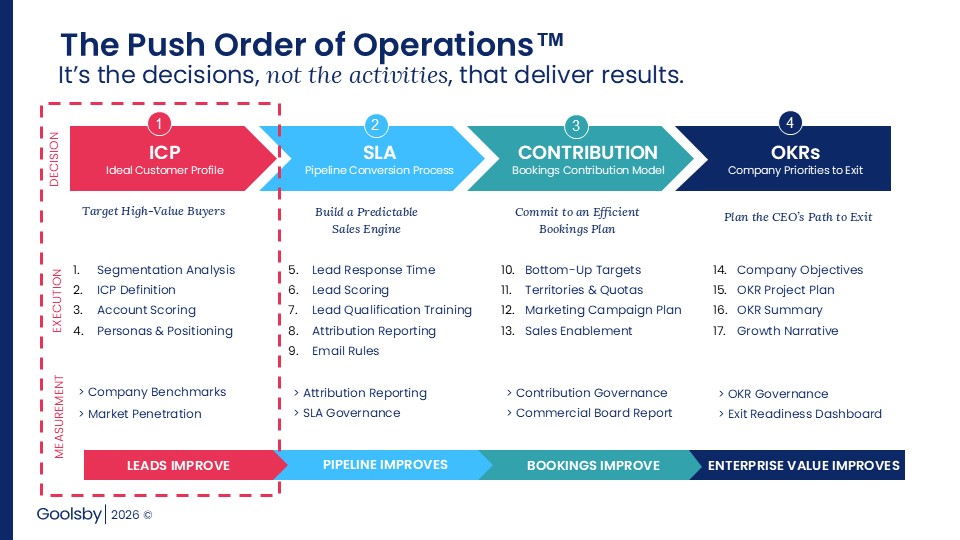
The ICP decision sits at the beginning of the Push Order of Operations because it informs every downstream activity. When it is clearly defined and validated, execution tends to become more consistent. When it is not, teams rely more heavily on assumptions, and coordination across functions becomes more difficult.
How should a PE-backed SaaS company define its ICP?
A PE-backed SaaS company should define its ICP through a structured, five-step process that aligns customer targeting with the investment thesis on a compressed timeline.
- ICP Workshop (CEO-led)
The leadership team defines initial hypotheses around which customer traits are most likely to drive high-value, low-churn accounts. - Data Preparation (RevOps)
CRM data is enriched to a usable level of completeness (typically ~60–75% complete) across key firmographic attributes. - Segmentation Analysis
Internal customer data is analyzed to identify which trait combinations correlate with stronger commercial outcomes, including deal size, sales cycle, win rate, customer lifetime, and churn. - Board Alignment (CEO)
Findings are reviewed with the board to confirm alignment with the investment thesis before moving into execution. - Operationalization (RevOps + Marketing)
Accounts are tiered in the CRM (A–D) using scoring logic, and personas and positioning are developed for priority segments.
This process typically takes ~65 days and results in a validated, data-backed ICP that connects directly to the value creation plan rather than a static persona document.
ICP vs. Persona: The Distinction That Shapes Execution
This is a common point of confusion in B2B SaaS and can lead to misalignment across teams.
ICP defines account-level traits. It describes the type of company a business is best positioned to target: industry, company size, geography, tech stack, revenue range, and growth stage. It answers the question: Which companies should we pursue?
Personas describe buyer-level characteristics within those accounts. They define the people involved in the buying process: job title, seniority, pain points, motivations, and decision-making authority. Personas answer: Who inside those companies should we engage, and what do they care about?
The sequence is important.
Personas are most effective when built within the context of a clearly defined ICP. The needs of a CTO at a $50M healthcare company can differ significantly from those of a CTO at a $50M retail company. While the role may be similar, the context: regulatory environment, buying process, and priorities varies meaningfully.
If personas are developed before the ICP is defined, messaging often becomes too broad to resonate consistently across segments.
In The Push Framework, ICP is defined first (Steps 1–4), followed by account scoring (Step 5), and then personas (Step 6). This sequencing ensures that accounts are prioritized before messaging is developed.
This is not just a definitional distinction, it is a sequencing decision that influences how well sales and marketing align on target accounts.
The Segmentation Analysis: Validating ICP With Your Own Data
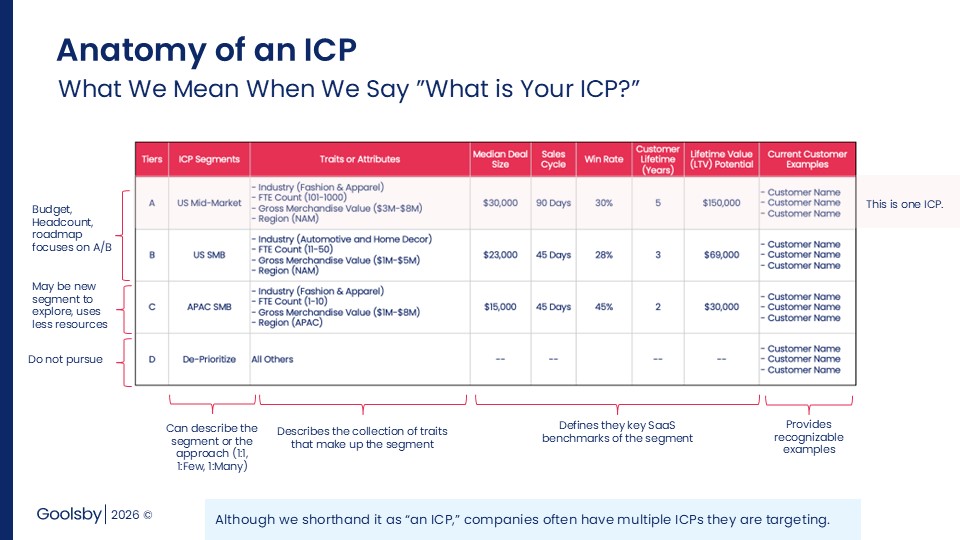
Segmentation analysis is the step that moves ICP from hypothesis to validation. It uses the company’s own CRM data to identify which customer segments are associated with stronger commercial outcomes.
The analysis typically looks at closed-won customers and active accounts across several dimensions:
Median deal size (ARR). Which segments tend to produce the largest initial contracts? Median is often more useful than average because it is less affected by outlier deals.
Sales cycle length. Which segments move from first qualified meeting to closed-won most efficiently? Shorter sales cycles can support faster revenue realization and lower cost of sale.
Win rate. Which segments convert from opportunity to closed-won at the highest rate? Higher win rates generally indicate more efficient use of sales capacity.
Customer lifetime. Which segments retain longest? Longer retention supports stronger lifetime value and reduces the need to replace lost revenue.
Churn rate. Which segments leave earliest? Higher churn can indicate weaker fit, even when initial deal size looks attractive.
Number of products attached. Which segments adopt multiple products? Multi-product adoption can signal expansion potential and stronger account durability.
ARR contribution. Which segments account for the largest share of recurring revenue? This helps show where the business is already concentrated today.
The analysis then cross-references these metrics against firmographic traits such as industry, employee count, geography, revenue range, and tech stack to identify which combinations are most consistently associated with ideal customers.
Data preparation is an important prerequisite. Before segmentation begins, CRM data typically needs to be enriched to a usable level of completeness (generally around 60–75% completed fields) across the firmographic attributes being analyzed. Common enrichment sources include ZoomInfo, Clearbit, LinkedIn Sales Navigator, and internal data from finance and product usage systems. The Push 100-Day Plan, allows 7 days for this step (Days 2–9).
Segmentation itself also requires time. The analysis usually runs over approximately 40 days (Days 10–50). It is not simply a survey or brainstorming exercise, but a structured analytical process that depends on clean data, cross-functional input, and iterative validation. When rushed, findings are often less reliable and harder for leadership teams to act on with confidence.
From Segmentation to Account Scoring: Making the ICP Operational
Segmentation identifies which customer profiles are most valuable. Account scoring translates those insights into the CRM so they influence how teams prioritize and operate day to day.
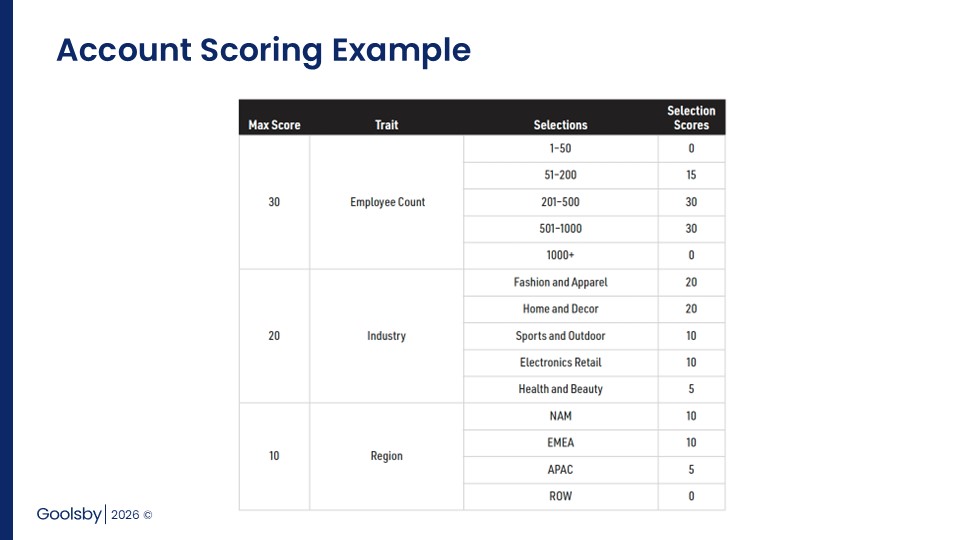
Account scoring assigns a numerical score to each account based on how closely it aligns with the ICP traits identified in segmentation. The logic is typically structured as follows:
Assign maximum points per trait.
Each firmographic attribute (industry, employee count, geography, revenue range) is given a maximum score based on its relative importance. Traits with stronger correlation to desired outcomes are weighted more heavily.
Score each selection value.
Within each trait, specific values receive different scores. For example, if certain industries consistently perform better, they receive higher scores, while adjacent industries may receive partial scores and non-target industries receive minimal or no score.
Define tier thresholds.
The total score creates a range that can be grouped into tiers. For example, Tier A accounts may represent the highest-fit segments and receive the most resources, followed by Tier B, C, and D with progressively lower prioritization.
Account scoring is often confused with lead scoring, but they serve different purposes.
Account scoring operates at the company level within the CRM. It informs which accounts sales prioritizes, how Customer Success segments its book, and which accounts Marketing targets for account-based programs.
Lead scoring operates at the individual level within the marketing automation platform. It tracks engagement signals—such as email activity, content downloads, and event participation—and helps determine when a lead is ready for sales follow-up.
In most cases, account scoring is established before lead scoring. Defining which accounts are a strong fit provides context for interpreting individual engagement signals. Without that context, teams may prioritize leads from accounts that are less likely to convert efficiently.
Account scoring can typically be implemented using standard CRM functionality. It does not necessarily require advanced tools. The primary requirement is clear scoring logic and someone who can configure it effectively. The Push 100-Day Plan allows 14 days for this step (Days 52–66).
Personas and Positioning: Targeting From Account to Buyer
Once account scoring identifies which companies to target, personas help define which individuals within those companies to engage and how to engage them.
The Push Framework outlines three common persona roles within each ICP segment:
Champion
The individual who recognizes the problem your product solves and advocates internally for a solution. This is often a mid-level leader—such as a Director or VP—who experiences the problem directly and has enough influence to initiate a buying process.
Decision-Maker
The individual who approves the budget and signs the contract. Typically a C-level executive or SVP. Their focus is less on features and more on business outcomes, such as revenue impact, risk reduction, operational efficiency, and competitive positioning.
User
The individual who will use the product day to day. Their priorities tend to center on usability, workflow integration, and whether the solution improves how they work. Their input can meaningfully influence the outcome of a deal.
Positioning statements provide teams with structured messaging for each persona within each ICP segment. A typical positioning statement includes three components: a value proposition (what you do), a differentiator (why your solution), and a proof point (evidence that it works).
The importance of ICP context becomes clear when comparing similar roles across different segments.
For example, a VP of Operations at a $50M healthcare SaaS company and a VP of Operations at a $50M retail SaaS company may share a title and similar responsibilities. However, their regulatory environment, operational challenges, buying process, and evaluation criteria can differ significantly. Messaging that does not account for this context tends to be less effective.
This is why personas are developed after the ICP is defined. The ICP establishes the context, and personas translate that context into buyer-level engagement.
Board Alignment: CEO Ensures ICP Connects to the Investment Thesis
Board alignment is often underemphasized in ICP work, but it plays an important role in whether the ICP is adopted and sustained across the organization.
It is not simply an informational update. It is a strategic discussion focused on whether the ICP findings align with the investment thesis, what the implications are for growth and M&A, and how the board can support execution in priority segments.
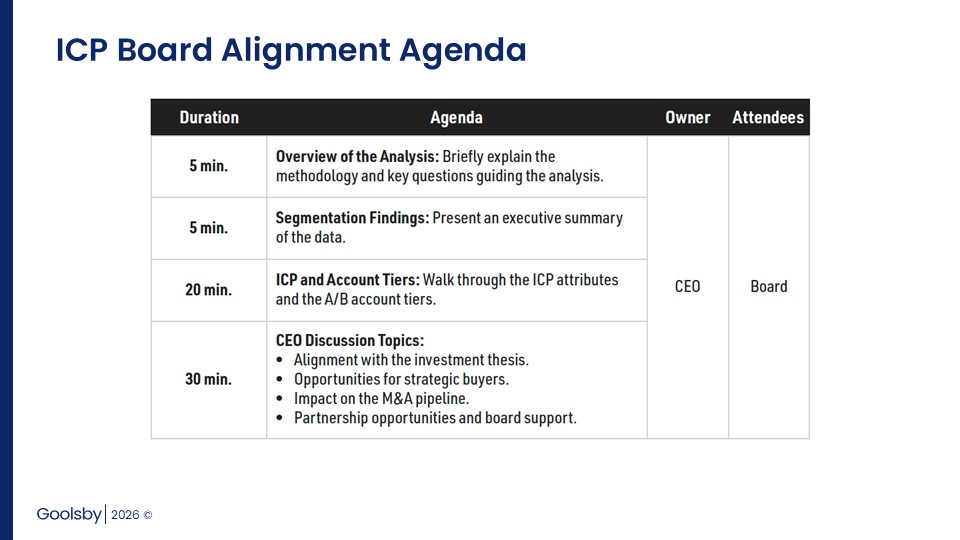
The recommended agenda:
Overview of Analysis (5 minutes)
Briefly explain how the segmentation analysis was conducted. The goal is to establish confidence in the rigor behind the findings.
Segmentation Findings (5 minutes)
Present a summary of the data, highlighting which segments performed best across deal size, sales cycle, win rate, retention, and LTV.
ICP and Account Tiers (20 minutes)
Walk through the A/B/C/D tier definitions, the traits that define each tier, and the strategic implications for targeting and resource allocation.
CEO Discussion Topics (30 minutes)
The CEO should guide discussion across a focused set of questions:
- Does this ICP align with the investment thesis?
If the thesis assumed growth in one segment but the data indicates stronger performance in another, this becomes a strategic decision point. - How do these findings affect the M&A pipeline?
High-performing segments may indicate areas where acquisition could accelerate growth. - Are there partnerships or relationships the board can help facilitate?
Board members often have networks within industries that can support execution. - Should the company consider adding a board advisor with relevant expertise?
In some cases, additional domain or segment-specific experience may be helpful.
Board alignment typically occurs after segmentation is complete but before execution begins (Day 51 in the Push 100-Day Plan). This sequencing allows for input on strategic direction before resources are committed to account scoring, persona development, territory design, and campaign planning.
Adjusting direction after those investments have been made can be costly and disruptive, which is why alignment at this stage is important.
The ICP Timeline
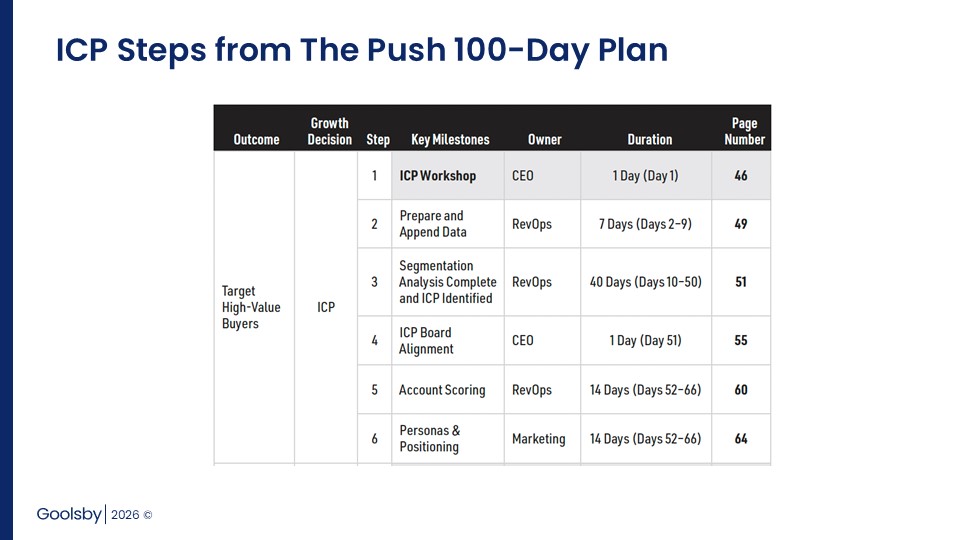
The ICP decision follows a structured sequence within the Push 100-Day Plan:
Day 1: ICP Workshop
The CEO facilitates a leadership session with heads of Product, Sales, Marketing, Customer Success, and RevOps. The session focuses on defining initial hypotheses around high-value, low-churn customer traits and assessing data readiness.
Owner: CEO
Days 2–9: Data Preparation
RevOps enriches CRM data to approximately 60–75% completeness across key firmographic fields. This typically includes consolidating customer account data, opportunity data, and product usage data, and appending missing fields through enrichment platforms.
Owner: RevOps
Days 10–50: Segmentation Analysis
RevOps conducts the analytical process—benchmarking company-level metrics and evaluating results across hypothesized segments to identify which trait combinations are most strongly associated with ideal customers.
Owner: RevOps
Day 51: Board Alignment
The CEO presents segmentation findings and ICP tier definitions to the board for discussion and validation against the investment thesis.
Owner: CEO
Days 52–66: Account Scoring and Personas & Positioning
These workstreams run in parallel. RevOps builds the scoring logic in the CRM, while Marketing develops persona profiles and positioning statements for priority segments.
Owner: RevOps and Marketing
The CEO’s role throughout
The CEO is not responsible for conducting the analysis, building the scoring model, or developing positioning. The CEO’s role is to prioritize the work, reinforce cross-functional coordination, remove obstacles that may slow progress and ensure alignment with the investor’s growth thesis before operationalizing the ICP across the business.
Maintaining visibility into progress and ensuring alignment across functions helps position this work as a shared priority across the leadership team.
How ICP Connects to Everything Downstream
ICP is not just a standalone deliverable. It functions as the targeting strategy at the center of the commercial execution system.
When ICP is validated and operationalized, it helps align multiple commercial functions:
ICP > Account Scoring > Territory Design > Quota Setting
Account scoring tiers the CRM. Territory design assigns reps to segments aligned with those tiers. Quota setting reflects the deal size, win rate, and sales cycle of each segment. When the ICP is misaligned, territories and quotas can become less accurate, which can impact attainment.
ICP > Personas > Campaign Targeting > Sales Messaging
Personas built on validated ICP segments support more relevant messaging. Campaign targeting focuses spend on audiences more likely to convert, and sales messaging aligns more closely with segment-specific pain points.
ICP > Product Roadmap Prioritization
When Product has clarity on which segments drive the most value, roadmap decisions tend to become more focused. Requests from higher-priority segments are weighted more heavily, helping maintain alignment with revenue strategy.
ICP > Customer Success Prioritization
Customer Success teams can use account scoring to determine where to apply proactive engagement versus scaled support. This helps protect retention in higher-value segments while managing resources more efficiently.
ICP > Bookings Contribution Model
The bookings contribution model defines how much pipeline and revenue each pipeline source (marketing, sales, partnerships, customer expansion) needs to deliver against the annual plan. When ICP segments are validated and tiered, contribution targets can be set by segment rather than as a single blended number. This allows leadership teams to allocate investment more precisely and gives the CFO a credible basis for testing whether the plan is achievable.
Without a clearly defined ICP, these downstream activities often rely on differing assumptions. Teams may operate with inconsistent definitions of the target customer, which can create misalignment across functions and reduce execution efficiency.
In the Push Framework, ICP is positioned first because it provides the inputs required for subsequent decisions.
FAQ
How long does the full ICP process take?
When managed internally, the full process typically takes approximately 66 days, from the ICP Workshop through account scoring and persona development. The segmentation analysis phase (Days 10–50) is usually the longest, as it requires clean-enough data, iterative analysis, and cross-functional validation. To move faster may require an external provider who specializes in segmentation analysis and has tools in place to support this kind of analysis.
What if our CRM data is not clean enough for segmentation?
Start with data preparation early (Days 2–9 are allocated for this in The Push 100-Day Plan). The goal is to reach roughly 60–75% data completeness (less blanks) across key firmographic attributes, not perfection. Many companies can achieve this within a week using enrichment platforms such as ZoomInfo or Apollo, combined with internal data sources.
Should we use AI for account scoring?
AI can help scale account scoring once the underlying logic is in place. However, it does not replace the need for a clearly defined ICP segments and scoring methodology. Many teams start with manual logic or basic CRM automation, validate that the tiers reflect actual outcomes, and then introduce AI tools to maintain and scale the model.
How often should we revisit our ICP?
ICP has a shelf-life of about 3-5 years and is most often revisited when a major business event is planned or needed such as a new investor, product launch, acquisition, market shift, change in the investment thesis or plateau or decline in commercial growth. Segmentation analysis can be re-run once there is sufficient new data, generally 6–12 months of closed-won activity, to validate whether patterns have changed.
Can a company have multiple ICPs?
Yes. Many SaaS companies serve multiple segments, each with distinct characteristics, deal economics, and buyer personas. The ICP framework helps prioritize these segments (e.g., A, B, C, D tiers) so that resources are allocated in line with their relative value.
What is the difference between ICP and TAM?
TAM (Total Addressable Market) represents the total potential revenue opportunity within a market. ICP defines the subset of that market a company is most likely to win and retain efficiently in this phase of growth. TAM is used for sizing; ICP is used for targeting and execution within that sized market.
Who owns the ICP decision?
The CEO owns the ICP decision. While the analysis and operational work are typically carried out by teams such as RevOps and Marketing, the CEO is responsible for prioritizing the effort, aligning the leadership team, connecting it to the investment thesis and ensuring the ICP is implemented consistently across functions.
Glossary
Segmentation Analysis
An analytical process that examines a company’s CRM data to identify which customer trait combinations are associated with stronger commercial outcomes (e.g., deal size, sales cycle, win rate, retention, LTV).
ICP (Ideal Customer Profile)
A firmographic profile that defines the type of company most likely to buy, retain, and expand. Typically defined at the account level using traits such as industry, company size, geography, revenue range, and tech stack.
ICP Tiers
A classification system (e.g., A, B, C, D) used to rank customer segments based on segmentation findings. Higher-tier accounts generally receive greater prioritization and resources.
Account Scoring
A CRM-based system that assigns numerical scores to accounts based on how closely they align with ICP traits. Used to inform sales prioritization, customer success segmentation, and territory design.
Lead Scoring
A system within a marketing automation platform (MAP) that scores individual leads based on engagement signals (e.g., email activity, content downloads, website visits). Often used to determine when a lead is ready for sales follow-up, typically in conjunction with account scoring.
Personas
Buyer-level profiles that describe the individuals within ICP accounts. Defined by role (e.g., champion, decision-maker, user), job title, seniority, pain points, and motivations.
Positioning Statements
Messaging frameworks used to communicate value to specific personas within defined ICP segments. Typically include a value proposition, differentiator, and supporting proof point.
TAM (Total Addressable Market)
The total potential revenue opportunity within a market if all possible customers were captured. Used primarily for market sizing rather than targeting.
Push Order of Operations
A structured sequence of four growth decisions (ICP, SLA, Contribution, OKRs) and associated execution steps used to organize commercial execution in PE-backed SaaS companies. ICP is the first decision in the sequence.
The ICP decision plays a foundational role in commercial execution. If the ICP has not been revisited since the PE acquisition—or if teams are operating with different assumptions about the target customer—it can create inefficiencies that compound over time.
A useful starting point is understanding whether the ICP itself needs to be redefined.
The Push Commercial Audit provides a structured diagnostic of your commercial execution, helping identify whether ICP misalignment is contributing to performance gaps and where the highest-impact opportunities exist.
For teams that are ready to move directly into alignment, the ICP Workshop is a facilitated session that guides leadership through segmentation hypotheses, data readiness, and ICP definition within a structured format designed for PE timelines.
Both are part of the Push Order of Operations and serve as entry points into the broader system.
February 26, 2026