

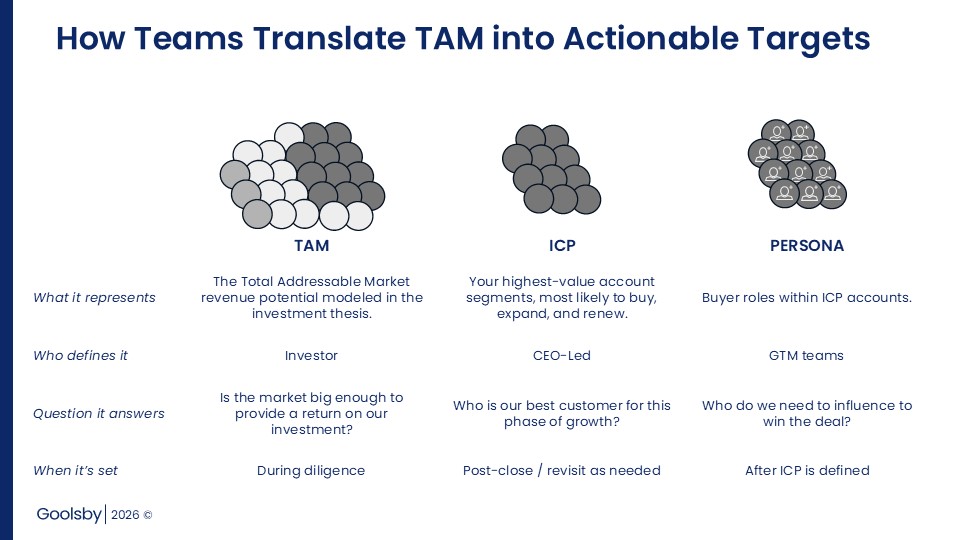
After a private equity investment, the ICP that got the company to that point is often no longer sufficient for what comes next.
Taking on investment is not just a capital event. It is a commitment to a specific growth path. For growth-stage companies, this typically involves some form of market expansion:
- Moving upmarket into larger accounts
- Moving downmarket for volume
- Expanding penetration within the existing segment
- Entering adjacent markets
Each of these shifts changes the requirements for customer targeting.
The segments that supported earlier growth or initial product-market fit may no longer align with the customer segments required to hit the next phase of growth targets.
An investment round is often a trigger event. It signals the need to re-validate the ICP against the new growth plan.
Companies that continue targeting the pre-investment audience often struggle to meet investor expectations around TAM penetration and growth.
The ICP was not wrong for the previous phase, but it may be wrong for the next one.
How should a PE-backed SaaS CEO fix a misaligned ICP after an acquisition?
A PE-backed SaaS CEO should treat ICP misalignment as an urgent diagnostic and reset it through a structured process that typically takes ~66 days.
The goal is not speed for its own sake, but building a validated ICP that can support predictable growth and align with the investment thesis.
The process follows a defined sequence:
- ICP Workshop (CEO-led)
A leadership session to define initial hypotheses around which customer traits are most likely to drive high-value, low-churn accounts in the context of the new investment thesis. - Data Preparation (RevOps)
CRM data is assessed and enriched to a usable level of completeness across key firmographic attributes. - Segmentation Analysis
A structured analysis of customer data to identify which segments perform best across deal size, win rate, sales cycle, retention, and expansion. - Board Alignment (CEO)
Findings are reviewed with the board to confirm alignment with the investment thesis before execution decisions are made. - Operationalization (RevOps + Marketing)
The ICP is translated into account scoring, tiers, and targeting logic to guide day-to-day execution across Sales, Marketing, and Customer Success.
This process typically takes ~66 days and results in a validated, data-backed ICP that can be operationalized across the business.
The risk is not that it takes 66 days. The risk is trying to scale against a misaligned ICP during that time.
The Pattern: What a Pre-PE ICP Looks Like and Why It Breaks
Before the acquisition, the ICP is often defined—but it is built for a different stage of the company.
It may be documented and used across teams, typically framed as: “we sell to mid-market financial services companies” or “our best customers are healthcare organizations with 200–500 employees.”
This definition is not wrong. It reflects real patterns from early customers and product-market fit. It guides hiring, product development, and go-to-market execution.
But a PE acquisition changes three things simultaneously:
Growth expectations increase.
The value creation plan typically requires 2–3x growth over a 4–5 year hold period. The ICP that supported $15M ARR organic growth may not support the path to $40M or $80M ARR.
Market focus narrows.
The investment thesis prioritizes specific segments, verticals, or geographies with the highest return potential. The existing ICP may include segments the thesis does not support—and exclude those it depends on.
Timeline compresses.
In a founder-led environment, targeting evolves over time. In a PE-backed environment, every quarter of misaligned execution has a measurable cost against the hold period.
The pre-PE ICP breaks because it was designed for a different growth context.
The company did not get it wrong. The context changed—and the ICP did not.
Three Signals Your ICP Is Misaligned
These are the diagnostic signals to look for early. If you recognize two or more, the ICP is likely misaligned with the value creation plan.
Signal 1: Reps Are Chasing the Wrong Accounts
This shows up as high activity but inconsistent results.
Reps are booking meetings, running demos, and generating pipeline, but conversion rates vary widely. Some hit quota; others miss by 30% or more.
Sometimes this is a talent issue, sometimes it’s a targeting issue.
Without a clear, validated definition of which accounts to prioritize, reps default to convenience, proximity, or whoever responds first.
When account scoring is missing or based on outdated ICP criteria targeting becomes rep-specific. The result is inconsistent pipeline quality and unpredictable attainment.
Signal 2: Deal Size Is Below Plan
Bookings are coming in, but average deal size is below the level required to hit growth targets.
The team may still be closing business, but not in the segments that support the model. Reps gravitate toward easier-to-close accounts, even if those deals are smaller or less strategic.
Over time, this creates a gap between activity and outcomes:
- Pipeline looks healthy
- Win rates may hold
- But ARR does not scale at the rate the plan requires
This may not be a pricing issue, it may be a targeting issue.
The Reps may be chasing customer segments that do not naturally support the deal economics required to hit plan.
Signal 3: Churn Is Concentrating in Specific Segments
Churn is not evenly distributed.
It concentrates in specific industries, company sizes, or use cases.
This is a signal those segments were never a strong fit. They were included in the ICP because they were part of the early customer base, not because they supported retention and expansion.
In a PE-backed environment, this has compounding impact: it reduces NRR, consumes Customer Success capacity, and weakens the growth narrative with the board.
Segmentation analysis will confirm this. But concentrated churn can be an early visible signal of ICP misalignment.
What to Do If Your ICP Is Misaligned
If two or more of the signals above are present, resist the instinct to jump straight into segmentation or an offsite.
The first step is not to redefine the ICP. The first step is to confirm that ICP misalignment is the binding constraint and not a symptom of something else.
A leadership team may see pipeline quality decline and assume an outdated ICP definition is the issue. After spending weeks redefining segments, they may come to find the real problem was how the ICP was applied across targeting, territories, or pipeline generation.
Step 1: Confirm the Problem (Diagnostic)
Before changing anything, run a structured diagnostic across four dimensions:
- Pipeline composition by segment
- Conversion rates by segment
- Deal size vs. plan
- Churn and expansion by segment
The question is specific:
Are we targeting the segments that can support our growth model?
If the answer is yes and performance is still off, the issue is downstream—typically in SLA governance or how targeting is operationalized.
If the answer is no—or unclear—ICP becomes the priority.
This diagnostic typically takes 2–4 weeks and can be run internally if RevOps can produce segment-level reporting, or through a structured diagnostic.
Step 2: Align on a Directional ICP (ICP Workshop)
Once misalignment is confirmed, the CEO convenes an ICP Workshop.
This is a leadership session designed to produce a working hypothesis, not a final answer.
The focus is to:
- Identify which segments are most likely to support deal economics and retention
- Align Sales, Marketing, Product, and CS on near-term targeting priorities
- Identify gaps in CRM data required for validation
The output is a directional ICP the business can execute against immediately, while the full analysis runs in parallel.
Step 3: Validate and Operationalize (66-Day Process)
The full ICP definition follows a structured process that includes:
- Data preparation and enrichment
- Segmentation analysis
- Board alignment
- Account scoring
- Personas and Positioining
- Territories and Quotas
- Campaign Planning
This is what turns a hypothesis into an operating system.
Account scoring embeds the ICP into the CRM so reps stop guessing. Personas translate the ICP into messaging. Board alignment ensures targeting decisions connect to the investment thesis.
What “Fixed” Looks Like — The Output Your Board Expects
After the 30-day reset, the CEO should be able to present the board with four things:
A validated hypothesis. The ICP traits that the company believes define its highest-value customers, based on leadership input and preliminary data analysis.
A data readiness assessment. An honest evaluation of CRM completeness and the enrichment plan to close the gaps.
A preliminary segmentation. Directional findings showing which segments produce the best deal size, win rate, sales cycle, and retention — with the caveat that the full analysis is still in progress.
An execution timeline. The remaining milestones to complete the ICP decision: full segmentation completion, board alignment discussion, account scoring build, and personas and positioning development.
This is not a final answer. It is a credible plan that shows the board the CEO has diagnosed the problem, taken action, and has a structured path to resolution. In a PE-backed environment, that combination — diagnosis, action, and a plan — is what builds board confidence.
FAQ
How quickly does ICP misalignment show up after a PE acquisition? The signals typically become visible 6–12 months after close. By that point, the company has gone through at least one territory planning cycle and one or two quarters of pipeline and bookings results that reveal whether the targeting strategy is working. The problem often exists from day one — it just takes two or three quarters of data to make it undeniable.
What if the PE firm has a strong view on which segments to pursue? The investment thesis provides a hypothesis, not a conclusion. The segmentation analysis validates whether the thesis aligns with what the company’s own data shows. In some cases, the data confirms the thesis. In others, it reveals that the highest-performing segments differ from what the thesis assumed. Either way, the CEO needs the data to have a credible conversation with the board.
Can we just update the old ICP instead of starting over? If the old ICP was never validated with data — if it was based on founder intuition or Series A assumptions — updating it is starting over. You need the segmentation analysis to determine which traits actually correlate with the best commercial outcomes. Patching an unvalidated ICP produces an updated guess, not a validated targeting strategy.
Does this require new tools or technology? No. The 30-day reset requires access to your CRM data, an enrichment platform for missing fields, and a RevOps person who can run the analysis. Account scoring can be built with basic CRM functionality. No new platforms are required.
What if our CRM data is in bad shape? Start the data assessment immediately. The ICP Workshop can still produce a valuable hypothesis even with imperfect data. Use the data assessment to prioritize which fields to enrich first based on the traits the workshop identified as most important. Perfect data is not the goal — usable completeness (60–75%) is.
Glossary
ICP (Ideal Customer Profile). A firmographic description of the type of company most likely to buy, retain, and expand. Defined at the account level using traits like industry, employee count, geography, and revenue range. → Full definition in the ICP Decision Framework
Segmentation Analysis. An analytical process that examines CRM data to identify which customer trait combinations correlate with the best commercial outcomes. → Methodology detail in the ICP Decision Framework
Investment Thesis. The PE firm’s rationale for acquiring the company, including the expected growth trajectory, target segments, and value creation levers.
Value Creation Plan. The operational plan that translates the investment thesis into specific milestones and metrics the CEO must deliver over the hold period. → Related: The CEO’s First 100 Days
Account Scoring. A CRM-based system that assigns numerical scores to accounts based on how closely they match ICP traits. → Full methodology in The ICP-to-Account-Scoring Pipeline
NRR (Net Revenue Retention). The percentage of revenue retained from existing customers over a period, including expansion and contraction. A key metric for PE boards evaluating portfolio company health.
Next Step
If you suspect your ICP is misaligned but are not sure where to start, the Push Diagnostic identifies the specific execution gaps across your commercial organization — including ICP validation, pipeline health, contribution modeling, and governance — in 2–4 weeks.
February 26, 2026